
Lab grown Diamond History

People have been trying to grow diamonds for centuries now, ever since it was discovered that they were made from carbon. After realising they were created from high temperatures and pressures beneath the earth's surface, scientists started their research into man-made crystals.

The first company to publish their results creating a synthetic diamond was General Electric in America. In 1954 they finally had a break through and grew the first lab-grown diamond. Over time the shapes and sizes could be better controlled and more consistent when reproduced. 
98% of today's industrial diamonds are grown synthetically and are used in the oil industry and manufacturing.

How are lab diamonds made?

The two ways to produce synthetic diamonds are high pressure high temperature (HPHT) and chemical vapor deposition (CVD). They are used for slightly different purposes but both produce high quality crystals to be used in jewellery. In both methods, a refined carbon source is used starting with a seed crystal to initiate growth. Once the stones are made, they are polished and cut by experts to produce a polished laboratory grown diamond. 
 
HPHT
 
HPHT is based on the initial discovery back in the 1950's. The process mimics the condition natural diamonds are formed in the earth's surface over billions of years; using high pressures and high temperatures of around 1300-1600 degrees Celsius., but instead of billions of years, only takes weeks to produce. HPHT is most commonly used to create diamonds up to 0.15ct, often referred to as "melee". The HPHT process can also treat natural diamonds to improve the quality (treated naturals have a similar value to lab created diamonds).
 
CVD
 
Chemical Vapor Deposition (CVD) uses moderate to high temperatures of around 700-1000 degrees Celsius and lower pressures than HPHT. Diamond seeds are placed in a plate spaced apart, meaning multiple diamonds can be grown at once. These stones grow upwards in thin layers and often have a brownish finish. They are then put into a HPHT machine to burn the brown off, leaving the crystals clear. Larger stones created using CVD often take around a month to form- so not too dissimilar to HPHT. The CVD process produces much higher quality diamonds as there is more control in this method. 
 
The lab grown diamonds sold at Avanti are made using the CVD process. Our manufacturer is only one of three in the world which are 'as grown', this means they are not treated afterwards unlike many laboratory grown diamonds available on the market. Lab-grown diamonds from places such as Hong Kong and India are grown very fast, producing low quality diamonds which are then treated. 

Natural VS Lab Grown

I wouldn't necessarily say there is a competition between the two stones, rather it depends on what you would like out of your jewellery piece. However, there are some comparatives that can be made to help you choose which is right for you. 
 
Price
 
Natural diamonds have the rare factor and therefore the value, historically, continues to rise. If people had the choice and didn't take price into consideration, most would go for a natural stone every time. If you like the look of a larger stone, lab made diamonds are often 50-70% cheaper than natural- so you certainly get more for your money. As these are still so new to the market it is hard to say what will happen with prices at the moment. However, with them being easily and quickly reproduced, it is unlikely that they will hold their value like natural diamonds and would certainly have a lower re-sale price tag. So, if you're investing in a diamond jewellery piece- natural would be the way to go.
 
Sustainability
 
Ethically, yes, it's true that lab grown diamonds don't have the mining conflict associated with them like natural diamonds do, but with work in place like the Kimberley Process, participants actively prevent 99.8% of worldwide trade. Diamond mining is much more controlled today, with the planning of opening a mine also involving a plan to return the environment back to how it was prior. However, in terms of sustainability, the electricity needed to create a synthetic stone using CVD is the equivalent of powering a home for a month. That being said, the process takes roughly a month from start to finish and if the power was created from solar panels, could this make a huge difference? Sustainability is a huge focus in the world right now, shown from clothing retailers using recycled materials all the way up to The Earthshot prize, awarded to businesses doing their best to come up with solutions that help the environment. 
 
The wonderful thing about natural and lab-grown diamonds is that you have a choice! Here at Avanti, we offer both a lab grown diamond option yet continue to specialise in beautiful natural diamond pieces.
 

Can you tell the difference between natural and lab grown diamonds?

To the naked eye and even through a loupe glass (magnification), you can't see a difference. Both natural and laboratory grown diamonds share the same chemical, physical and optical properties. They are both made from crystalline carbon and measure 10 on the hardness scale. The only difference is how and where the diamonds are grown and the length of time. It is these growth histories that a laboratory uses to detect a synthetic stone in a gem lab. 

Lab grown diamond FAQ

Are lab grown diamonds real?

Yes! Laboratory grown diamonds are real they are just grow in a lab environment rather than formed naturally in the Earths' mantle. They are the same properties, characteristics and cryptical structure as natural diamonds including the 4C's (cut, clarity, carat and colour) and are a 10 on the measure of hardness scale. 

How much cheaper are lab grown diamonds? 

Currently they are 50-70% cheaper than natural diamonds. However, this may change if they become easier to produce. 

How do I care for my lab grown diamond jewellery? 

Exactly the same way you would care for a natural diamond. Take your piece to a local jewellers and ask for you the setting and stone to be professionally checked. To remove any dirt and oils place your piece in warm soapy water and use a soft old toothbrush to clean. 

Should a lab grown diamond be certified? 

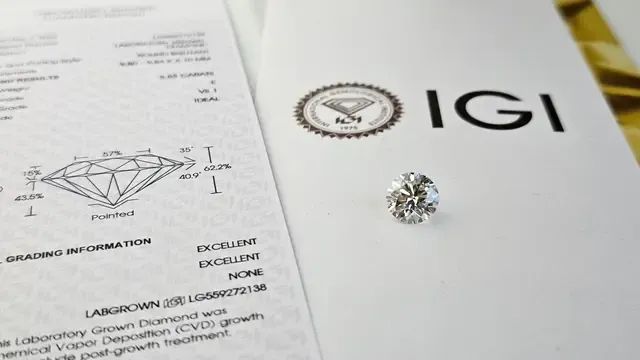
Yes! Lab grown diamonds are certified in the same way as natural diamonds are and by the same grading bodies; GIA, IGI and AGS. However, GIA released on June 2nd 2025 that they will be changing the way they grade lab created diamonds into either "premium" or "standard". GIA expect to roll this new change out by the end of 2025. 
Cart

loading